What Happens When Multiple Retail Leases Expire at the Same Time?
Retail Lease Expiration Risk: What Orange County Property Owners Need to Know Before It's Too Late
By Jim Resha
Senior Vice President, Sperry Commercial | The Resha Group
National Chair, Sperry National Retail Group
Most retail property owners in Orange County have a solid handle on their occupancy numbers.
They know which tenants are paying, which spaces are dark, and what percentage of the center is leased. On paper, that creates confidence. Sometimes too much of it.
Because one of the most significant risks in retail ownership doesn't show up in your occupancy report. It hides in your lease expiration schedule.
A center can look financially healthy today while quietly accumulating serious risk for tomorrow. When multiple leases cluster around the same expiration window, owners can face simultaneous pressure on income, valuation, lender perception, and negotiating leverage. All at once, with limited time to respond.
This is one of the most overlooked dynamics in Orange County retail real estate. And it's one of the first things we examine when working with property owners.

Why High Occupancy Can Mask a Fragile Rent Roll
A property running at 95% occupancy sounds strong. And in many ways, it is.
But if 45% of your rent roll expires within the next 24 months, the picture changes significantly.
Sophisticated buyers, institutional lenders, and experienced investors don't evaluate commercial retail properties on occupancy alone. They look deeper:
Lease expiration schedules and clustering
Tenant category concentration
Renewal probability by tenant type
In-place rent versus current market rent
Co-tenancy clause exposure
Credit quality of anchor and inline tenants
A high-occupancy center with concentrated lease rollover can still carry a risk profile that discounts its value. And the market knows it.

Why Lease Rollover Risk Is More Significant in 2026
Retail real estate is operationally more sensitive than many owners realize, and the 2026 environment reinforces that.
Tenant demand has shifted across categories. Labor costs remain elevated. Consumer spending continues to evolve. Some retail categories are thriving. Others are quietly under pressure.
That means renewals shouldn't be assumed, even for long-term tenants.
In today's environment, retail tenants at decision points are more likely to:
Negotiate aggressively on rent and term
Request tenant improvement allowances or free rent periods
Reduce square footage or reconfigure their space
Delay renewal decisions to preserve flexibility
Explore alternative locations with better economics
When several tenants reach that decision point simultaneously, the owner loses the ability to manage the process from strength. The conversation shifts from strategic to reactive, and that shift is expensive.
The Real Cost of Clustered Lease Expirations
This is where the risk becomes concrete. The following five issues tend to surface together when rollover is concentrated, and each one compounds the others.
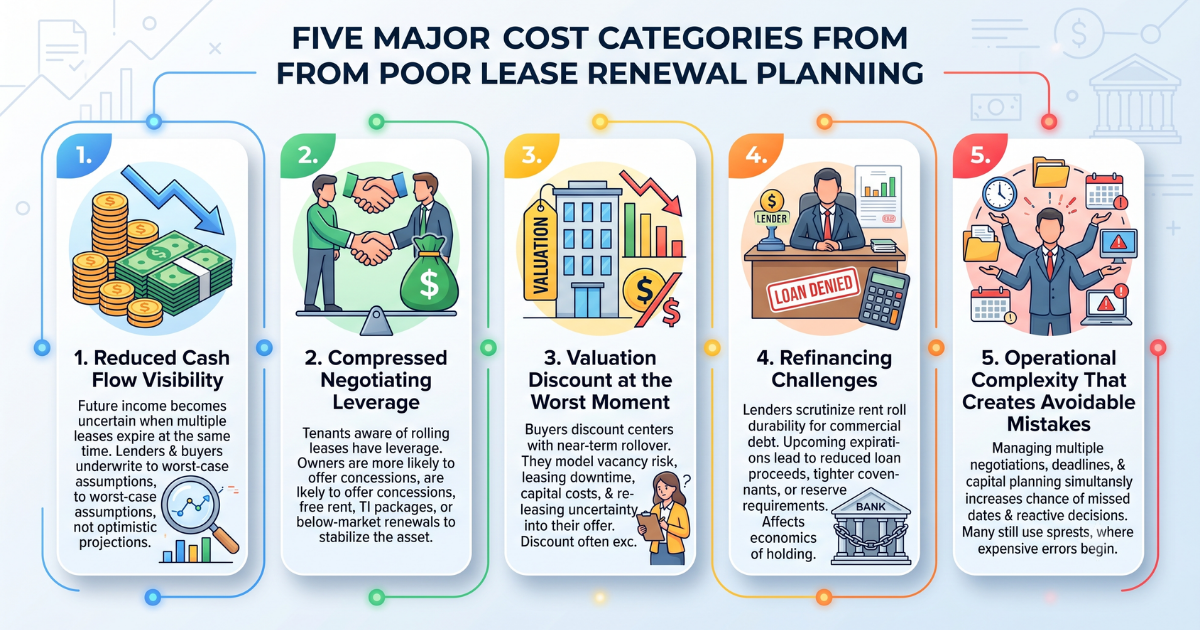
1. Reduced Cash Flow Visibility
When multiple leases approach expiration at the same time, future income becomes uncertain. Lenders and buyers underwrite to worst-case assumptions, not optimistic projections.
2. Compressed Negotiating Leverage
Tenants aware that multiple leases are rolling have leverage. Owners in that position are more likely to offer concessions, free rent, TI packages, or below-market renewals, just to stabilize the asset.
3. Valuation Discount at the Worst Moment
Buyers discount centers with near-term rollover concentration. They model vacancy risk, leasing downtime, capital costs, and re-leasing uncertainty into their offer. That discount often exceeds what owners expect.
4. Refinancing Challenges
Lenders scrutinize rent roll durability when underwriting commercial real estate debt. A center with major upcoming expirations can face reduced loan proceeds, tighter covenants, or reserve requirements. All of which affect the economics of holding.
5. Operational Complexity That Creates Avoidable Mistakes
Managing multiple lease negotiations, legal notice deadlines, renewal windows, and capital planning timelines simultaneously increases the chance of missed dates and reactive decisions. Many owners still run this on spreadsheets. That's where expensive errors begin.
Orange County Retail Market Context
Orange County retail fundamentals remain relatively stable compared to many markets nationally. But pricing here rewards durability and punishes perceived risk quickly.
Based on recent Orange County retail capital markets data, average cap rates were running around 5.2% in 2024, approximately 5.3% for neighborhood centers and 5.1% for general retail. In an environment with compressed cap rates, even a modest increase in perceived risk can move value materially.
When two comparable properties come to market and one has a staggered expiration schedule while the other has clustered rollover in the next 18 months, buyers notice. And they price accordingly.
What Disciplined Owners Do Differently
The owners who manage this risk most effectively don't wait until tenants are 90 days from expiration. They review rollover exposure two to four years in advance and ask the right questions early:
Which tenants are essential to the center's identity and co-tenancy structure?
Which tenants are likely to renew, and which may be evaluating other options?
Are below-market rents creating opportunity or setting up future friction?
Should certain leases be extended proactively before the window closes?
Is this the right time to sell while occupancy and income appear strongest?
Does it make more sense to refinance now, while the rent roll looks clean?
That kind of forward thinking is portfolio management, not reactive property management. The difference in outcomes, financial and operational, is significant.
A Scenario Worth Considering
Two Orange County retail centers. Both running at 96% occupancy. Both in similar trade areas.
Center A has lease expirations spread across the next seven years. Center B has 55% of its gross rent expiring within the next 18 months.
Same occupancy rate. Completely different risk profile.
One offers a lender and buyer a durable income stream. The other requires execution and offers leverage to the tenant side of the table.
Sophisticated capital understands the difference immediately. The question is whether the owner does too, and whether they recognize it early enough to act strategically.

The Strategic Question Most Owners Aren't Asking
Many Orange County retail owners focus on one question: What is my property worth today?
That matters. But a more important question often determines the answer:
What will my rent roll look like when I need to refinance, sell, or negotiate from a position of strength?
Owners who ask that question early have options. Owners who ask it late are often managing around constraints they didn't see coming.
How The Resha Group Can Help
At The Resha Group, we work with Orange County retail property owners to evaluate more than surface-level metrics. Before recommending a course of action, we review:
Lease expiration concentration and rollover timing
Tenant durability and renewal probability
Sell versus hold versus refinance timing
Refinancing readiness relative to rent roll health
Capital planning and repositioning needs
Portfolio-level risk exposure across all assets
Because many ownership problems that appear suddenly were visible years earlier, if someone was looking.
Before Your Next Move, Review Your Rent Roll
If you own retail property in Orange County and haven't reviewed your lease expiration schedule recently, now is the time to do it, before the market does it for you.
Rollover risk that looks manageable today can compound quickly when multiple decisions land at the same time.
[Download The Capital Decision Worksheet] to evaluate your property's risk profile and clarify your next strategic move.
Or contact The Resha Group directly for a confidential review of your property, rent roll, and options. No obligation, no pitch. Just clarity.
